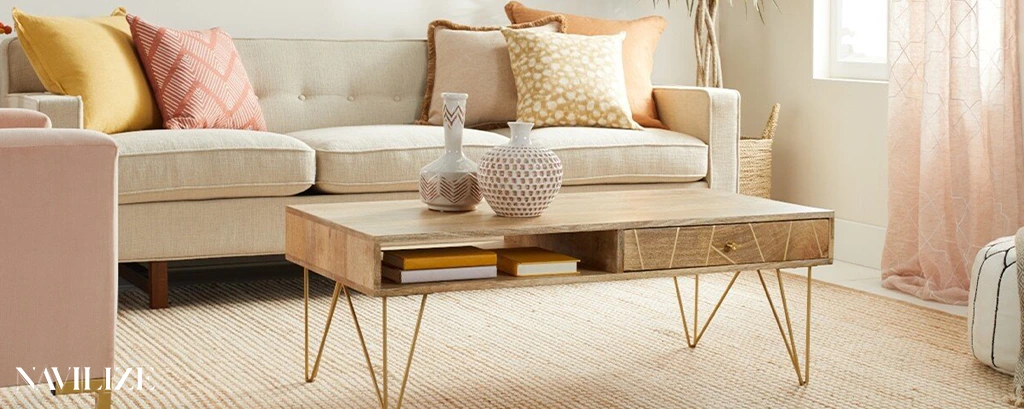
There’s a moment in almost every living room project when a client sends me a photo of a coffee table they’ve fallen in love with — and it’s completely wrong for their space. Too tall, too wide, too far from the sofa, or so small it looks like it wandered in from a different room entirely.
Getting coffee table dimensions right isn’t complicated, but it does require knowing a few specific numbers. After years of helping clients furnish living rooms that actually work, I’ve put together everything you need to make a confident decision.
How Big Should a Coffee Table Be?
The most reliable rule: your coffee table should be roughly two-thirds the length of your sofa. So if your sofa is 90 inches long, you’re looking for a coffee table in the 54–60 inch range. This proportion keeps the table from looking either overwhelmed by the sofa or like it’s trying to compete with it.
For width, most coffee tables fall between 18 and 24 inches. That’s enough surface area to be genuinely useful — drinks, books, a tray — without eating up floor space.
A few practical benchmarks:
- Small sofa (72″): coffee table around 48″
- Standard sofa (84–90″): coffee table 54–60″
- Large sectional: consider two smaller tables or a rectangular table up to 72″
One thing I see constantly: people buy a coffee table that looks great in the store and then discover it’s either too small to reach comfortably from the sofa or so large it blocks traffic flow. The two-thirds rule solves both problems at once.
For sectionals specifically, a large square or round table often works better than a long rectangular one — it gives everyone on the L-shape equal access to the surface.
| Coffee Table Size by Room & Sofa Type | |||
|---|---|---|---|
| Room / Sofa Size | Recommended Table Size | Ideal Shape | Notes |
| Small room / loveseat (under 72″) | 24″–36″ long | Round or square | Round edges prevent injury in tight spaces |
| Medium room / standard sofa (72″–84″) | 36″–48″ long | Rectangle or oval | Aim for 2/3 of sofa length |
| Large room / sectional (over 90″) | 48″–60″ long | Large rectangle or two ottomans | Two smaller tables offer flexibility |
| Open-plan / L-shaped sectional | 48″+ or dual tables | Square or two rounds | Square anchors the corner better |
Coffee Table Height Guidelines
This is the detail most people overlook entirely, and it makes a bigger difference than almost anything else.
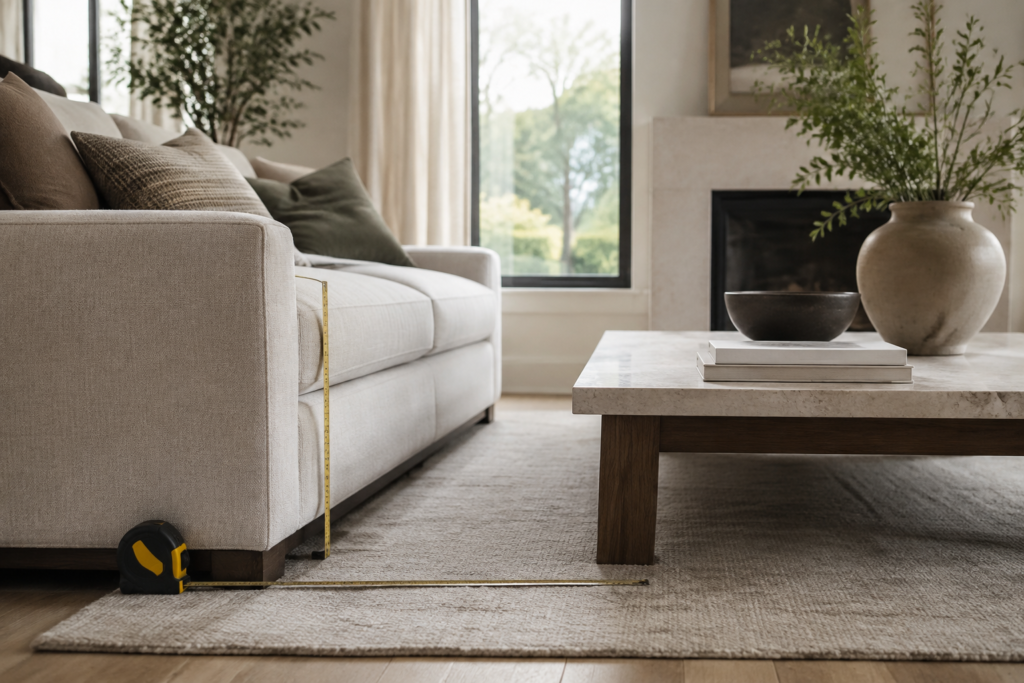
The standard recommendation is that your coffee table should be within 1–2 inches of your sofa’s seat height — either level with it or slightly lower. Most sofas sit between 17 and 19 inches from the floor. That puts the ideal coffee table height at 16–18 inches for most living rooms.
Why does this matter? A table that’s too low forces you to lean forward awkwardly every time you reach for a drink. A table that’s too high feels like a barrier between you and the rest of the room — and it looks wrong even if you can’t immediately identify why.
Before you buy, measure your sofa’s seat height. It takes 30 seconds and saves a lot of frustration.
A few exceptions worth knowing:
- Lounge-style sofas with very low seats (14–15″) pair well with tables in the 14–16″ range
- Higher, more formal sofas (19–20″) can accommodate tables up to 20″
- Ottomans used as coffee tables are typically 17–18″ — they work well precisely because they match sofa height almost exactly
Ideal Distance Between Sofa and Coffee Table
The number here is specific: 14 to 18 inches between the front edge of your sofa and the nearest edge of the coffee table.
Fourteen inches is the minimum for comfortable legroom — enough to stand up without shuffling sideways. Eighteen inches is the practical maximum before the table starts to feel disconnected from the seating, like you have to lean forward just to reach it.
I’ve seen both mistakes made in real rooms. A client once pushed her coffee table flush against the sofa because she thought it looked more intentional. Within a week she’d bruised her shins twice and moved it back. On the other end, another client left nearly two feet of space because she was worried about the room feeling cramped — and the table ended up looking like it belonged to a different furniture arrangement entirely.
The 14–18 inch range isn’t arbitrary. It’s the distance at which a seated person can comfortably reach the table surface without straining, and stand up without stepping around it.
If you have young children or frequently move through the space, stay closer to 18 inches. If the room is small and traffic flow isn’t an issue, 14–15 inches keeps everything feeling cohesive.
Best Coffee Table Shape for Different Rooms
Shape affects both function and how the room feels — and it’s worth thinking through before you default to the most common rectangular option.
Rectangular tables are the most versatile. They mirror the linear shape of most sofas and work well in rooms where traffic flows around the sides. If you have a standard sofa against a wall, rectangular is almost always the right call.
Round tables are genuinely better in certain situations: small rooms where sharp corners would be a hazard, rooms with a lot of curved furniture, or any space where children are regularly present. A round table also tends to make a room feel more relaxed and conversational. The tradeoff is surface area — a round table gives you less usable space than a rectangular one of similar footprint.
Square tables work best with sectionals or L-shaped seating arrangements. They give everyone roughly equal access to the surface, which a long rectangular table can’t do when people are seated on perpendicular sides.
Oval tables are an underused option that combines the length of a rectangle with the softer edges of a round table. They’re particularly good in narrow rooms where a rectangular table would feel too boxy.
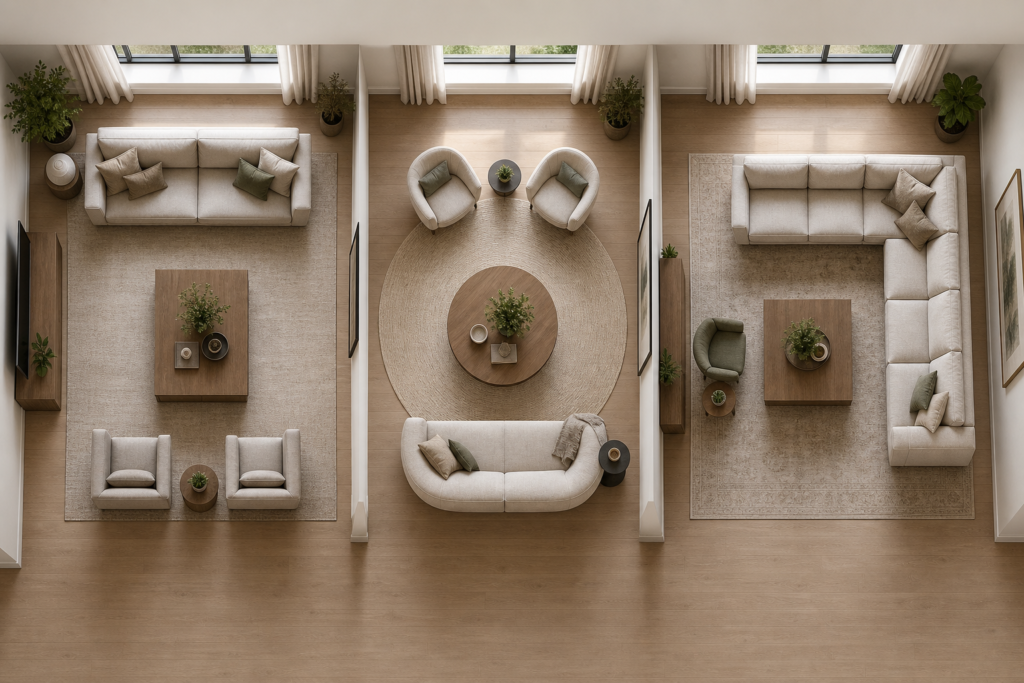
One thing I always tell clients: if your room has a lot of straight lines — rectangular sofa, square rug, angular shelving — a round or oval table adds visual relief. If the room already has a lot of curves, a rectangular table grounds it.
For help thinking through how shape, scale, and layout work together in your specific space, the team at Navilize offers interior design services built around exactly these decisions.
Common Coffee Table Sizing Mistakes
After years of seeing what goes wrong, these are the errors that come up most often.
Buying too small. This is the most common mistake by far. People worry about a table overwhelming the room and end up with something that looks like an afterthought. If you’re between two sizes, go larger. A table that’s slightly too big reads as intentional; one that’s too small just looks like you haven’t finished furnishing the room.
Ignoring seat height. Most people measure floor space and forget entirely about height. A beautiful table at the wrong height will bother you every single day.
Getting the distance wrong. Either pushed too close (shin hazard, cramped feel) or too far (disconnected, hard to reach). Measure 14–18 inches and mark it with tape before you buy.
Choosing shape by default. Rectangular is fine, but it’s not always right. Think about your seating arrangement and traffic flow before defaulting to the most common option.
Not accounting for the rug. If you have an area rug, the coffee table will sit on it. A table that looks proportional on a bare floor can look completely different once it’s on a rug — especially if the rug is small. Visualize the full arrangement before committing.
Prioritizing looks over function. A glass-topped table with a sculptural base might be stunning, but if you have toddlers or a dog, you’ll spend more time worrying about it than enjoying it. The best coffee table is one you can actually use.
FAQ
What is the standard coffee table size?
Most standard coffee tables are 48–54 inches long, 18–24 inches wide, and 16–18 inches tall. These dimensions work well with a typical 84–90 inch sofa in an average-sized living room. That said, the right size depends on your specific sofa length and room layout — the two-thirds rule is more reliable than any single standard measurement.
How do I know if my coffee table is the right height?
Measure your sofa’s seat height from the floor. Your coffee table should be within 1–2 inches of that number, either level or slightly lower. If your sofa seat is 18 inches high, look for a table between 16 and 18 inches tall.
How far should a coffee table be from the sofa?
14 to 18 inches is the standard recommendation. This gives you enough legroom to stand comfortably while keeping the table close enough to reach without leaning. If you have children or need more traffic flow, stay toward the 18-inch end.
Should a coffee table be lower than the sofa?
Slightly lower is ideal — within 1–2 inches below seat height. A table that’s level with the sofa seat is also fine. What you want to avoid is a table that’s noticeably higher than the sofa seat, which creates an awkward visual barrier and makes the table harder to use comfortably.
What size coffee table works with a sectional?
For most sectionals, a square or large round table works better than a long rectangular one, since it gives people seated on both sides of the L-shape equal access. Aim for a table that’s roughly two-thirds the length of the longer section of the sectional.
Can a coffee table be too big?
Yes, but it’s less common than going too small. A table that extends beyond the length of the sofa, or leaves less than 14 inches of clearance, is too large for the space. The bigger risk for most people is choosing something too small — when in doubt, size up.